



Source: GTI Forum, AI for Good 2026, Geneva
UN Geneva Conference Week: Three Flagship Events Running Concurrently
From July 6 to 10, 2026, the International Telecommunication Union (ITU) of the United Nations hosted an unprecedented Conference Week in Geneva, comprising three core flagship gatherings:
The Global Dialogue on AI Governance (July 6 to 7), the UN’s first dedicated dialogue centered on AI governance, with opening remarks delivered by multiple high-level government representatives including Li Lecheng, Minister of Industry and Information Technology of China.
The AI for Good Global Summit (July 7 to 10).
The World Summit on the Information Society (WSIS).
Throughout the conference week, a wide range of global institutions and enterprises hosted diverse thematic side events to exchange insights on AI governance, digital infrastructure and sustainable development.
Two dedicated side events were co-organized by the UN Consultative Committee on Open Source Innovation (CCOSI) and the Open Source Technology Committee of the China Institute of Communications, with collaborative support from Tsinghua University’s School of Software and Timecho, bringing together cross-border open-source stakeholders for exchange.
Open Source Fuels Global AI Innovation
On July 9, an AI for Good side event titled Open Source for AI Prosperity — the third special session of the GTI Forum's Mobile AI for Good — was held at Geneva's Palexpo Exhibition Centre.
Jianmin Wang, Professor at Tsinghua University, delivered a keynote address titled Open Source Promotes Global AI Innovation.
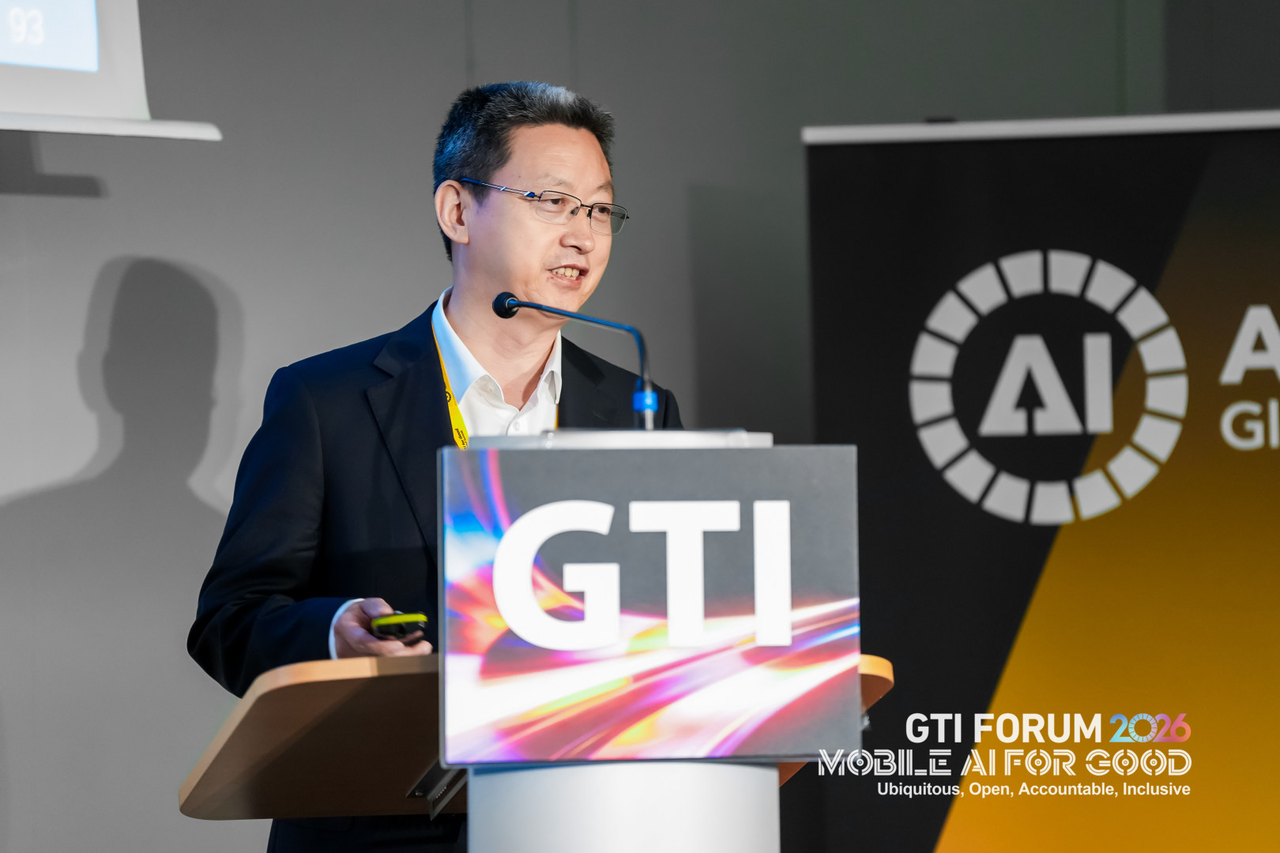
Source: GTI Forum, AI for Good 2026, Geneva
Drawing on decades of hands-on open-source practice, Professor Wang traced the 15-year evolution of Apache IoTDB, a global collaborative industrial open-source project launched in 2011. Built specifically for the Industrial Internet of Things (IIoT), IoTDB delivers core strengths such as high-throughput data ingestion, high-compression storage and low-latency querying, forming a fundamental building block for industrial time-series data infrastructure.
Today, IoTDB is an Apache Software Foundation Top-Level Project, nurturing a global open-source community of nearly 10,000 users spanning roughly 60 nations. Its real-world deployment with Deutsche Bahn was featured in the Apache Software Foundation’s annual report as a flagship use case embodying Open Source for Good principles. TsFile, its underlying storage format, has also been integrated as a native dataset format on Hugging Face, the world’s leading AI developer community.
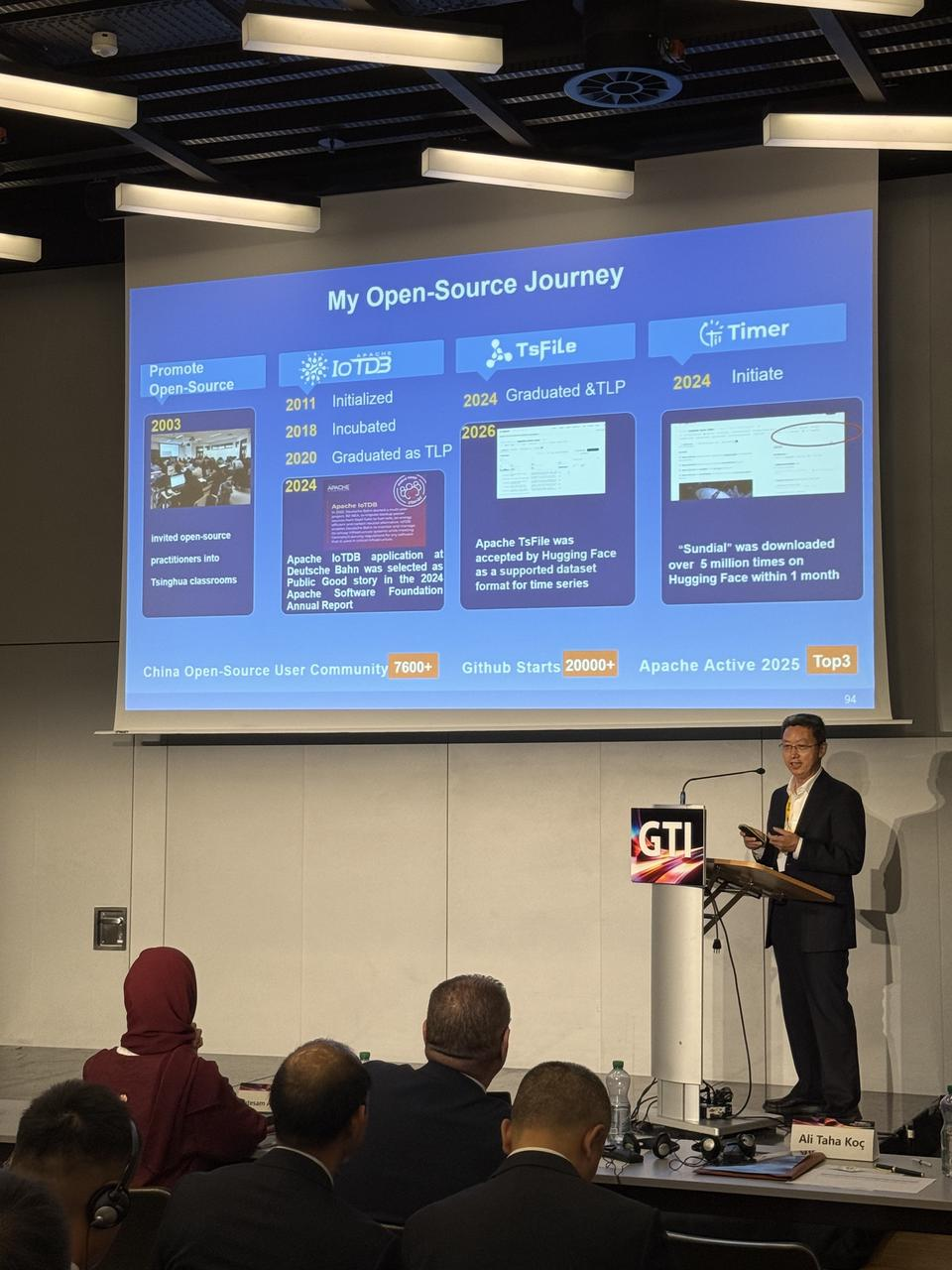
Source: GTI Forum, AI for Good 2026, Geneva
Within the AI domain, the Timer series of time-series foundation models exceeded 5 million downloads just one month after launching on Hugging Face, demonstrating robust global developer demand for specialized time-series AI tooling. As an integrated time-series data infrastructure suite for industrial intelligence, Apache IoTDB and the Timer series jointly build a complete "database + AI" technology stack that provides end-to-end support for industrial use cases from raw data management to intelligent predictive analytics.
He further detailed CCOSI’s core mission: advancing cross-domain open-source innovation across software, artificial intelligence and hardware. He also unveiled the preview edition of the 2026 Global Open Source Development Report at the summit.
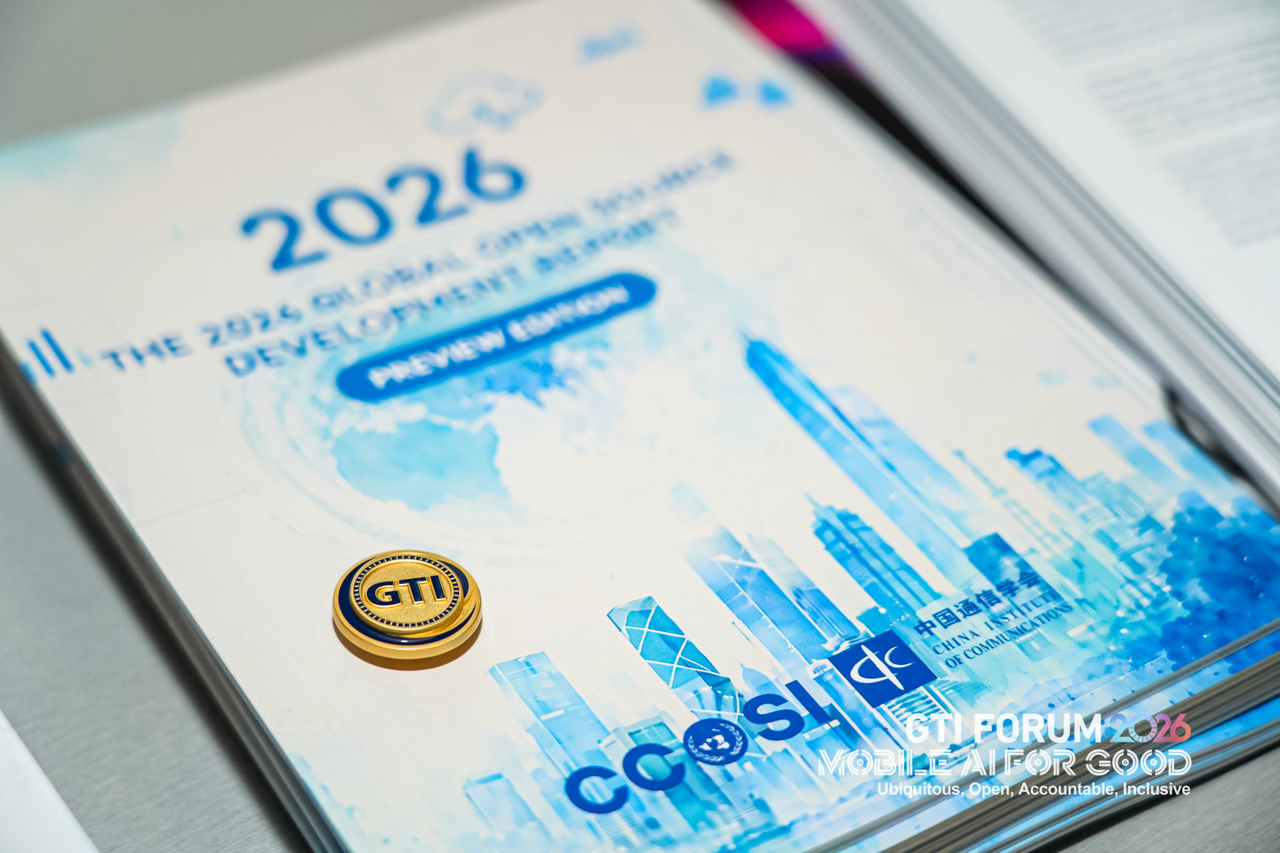
Source: GTI Forum, AI for Good 2026, Geneva
The Value of Open Source: Community, Industry, and Sustainability
In the subsequent roundtable discussion, the guests exchanged in-depth insights from diverse perspectives.
Christofer Dutz, Director of the Apache Software Foundation, shared insights on global open source community governance.
Prof. Dr. Mathias Gabrysch from Munich University of Applied Sciences presented feedback from Europe’s industrial sector.
Professor Yue Gao (Fudan University) and Professor Wei Wang (East China Normal University) joined the dialogue, focusing on academic research and open-source ecosystem assessment respectively.
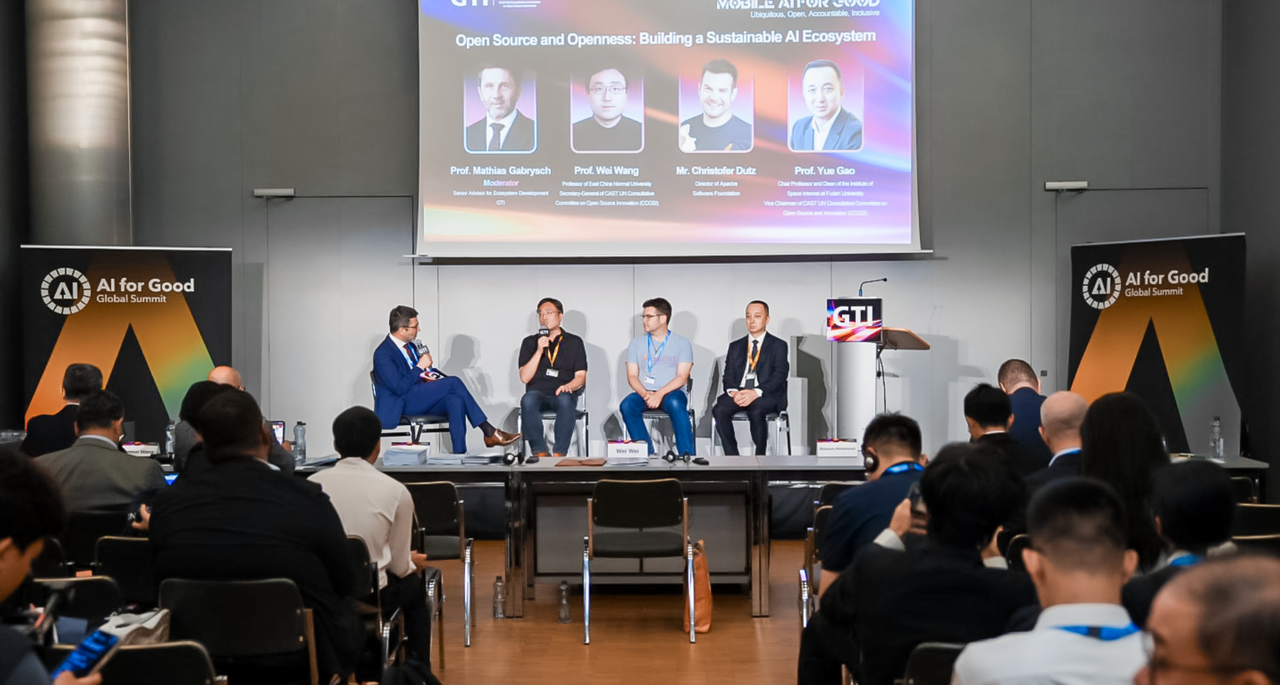
Source: GTI Forum, AI for Good 2026, Geneva
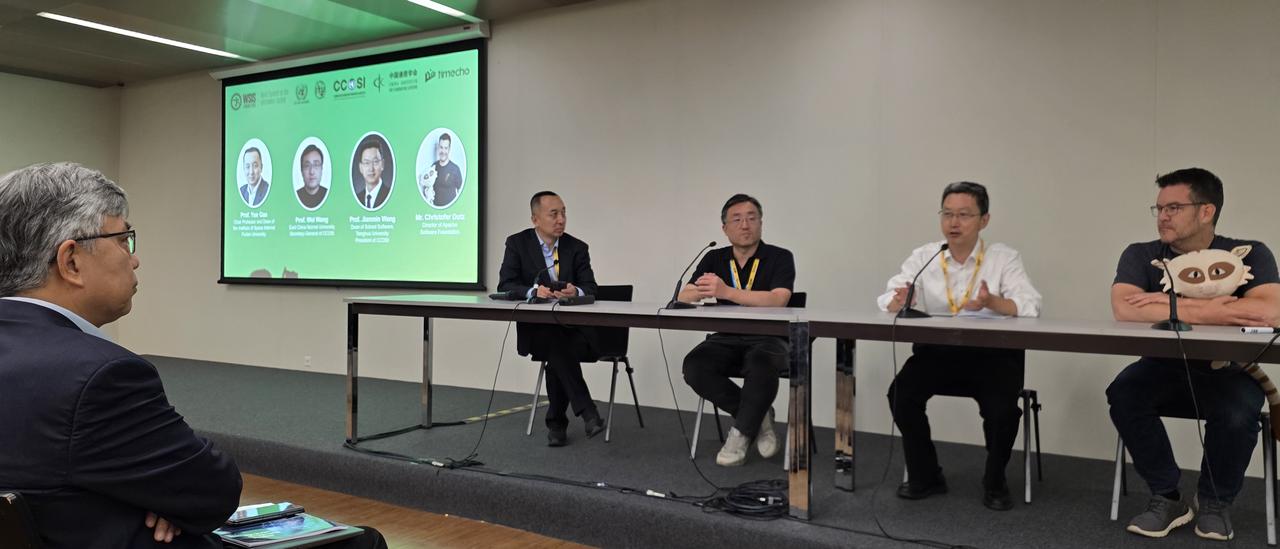
The WSIS side event on July 10 carried the theme Open Source and AI for Sustainable Development: Digital Infrastructure, Open Data, and Multi-stakeholder Cooperation. Moderated by Professor Yue Gao, the panel included Professors Jianmin Wang and Wei Wang alongside Christofer Dutz.
Centered around the United Nations Sustainable Development Goals (SDGs), the session enabled in-depth dialogue covering critical themes: how open-source technologies and AI can drive global sustainable development, trade-offs between open-source frameworks and proprietary closed datasets, and the opportunities and risks multimodal large models bring to open-source ecosystems.
Open source represents far more than a technical collaboration model; it embodies a governance philosophy that fosters global knowledge sharing and bridges the digital divide. Achieving the Sustainable Development Goals hinges on open, trustworthy and collaborative digital infrastructure.
Source: GTI Forum, AI for Good 2026, Geneva
Building an Inclusive Global Open-Source AI Ecosystem
Dialogues held in Geneva have delivered new perspectives on global AI governance and sustainable development. As AI grows deeply embedded in critical infrastructures spanning industry, energy and transportation, governance frameworks and collaborative mechanisms for open-source technologies must evolve in tandem.
As one such initiative, Apache IoTDB, a global open-source industrial time-series database paired with the Timer series of time-series foundation models creates an integrated open-source technology stack covering storage, inference and prediction, delivering lightweight, cross-domain reusable foundationalg industrial AI tools for developers worldwide. This vision is shared by the entire global open-source community, aligns with the core values championed by AI for Good and WSIS, and serves as a tangible response to the United Nations Sustainable Development Goals.


