


Factories, power systems, trains, aircraft, and buildings all have something in common: their equipment keeps producing measurements.
A temperature sensor may report a reading every second. A motor may generate vibration readings many times per second. A power meter may record consumption at regular intervals. These values are not isolated data points. Their meaning depends on the time they were measured, the device they came from, and the signal being observed.
That is the core idea behind time-series data—and the reason databases designed for time-series workloads exist.
What makes data a time series?
A time-series data point pairs a timestamp with a measured value. In an IoT system, it is also associated with a device and a measurement. For example:
An individual reading captures one moment. A sequence reveals how the system changes over time—whether temperature is rising, vibration is drifting, or an operating pattern is shifting. This temporal context makes time-series data useful for monitoring and operational analysis.
Why do IoT workloads need a time-series database?
IoT systems generate continuous measurements from many devices, often at different frequencies and sometimes out of order. Applications need to ingest those readings, retain growing histories, retrieve specific time windows, and compare or aggregate signals across time.
Organizations commonly use relational databases such as MySQL, PostgreSQL, and Oracle Database to manage structured business data. These systems are well suited to transactional processing, data relationships, and general-purpose queries.
However, when industrial IoT applications continuously write large volumes of timestamped measurements, a general-purpose relational design may require additional indexing, partitioning, storage, and maintenance as the history grows. A purpose-built time-series database organizes data and queries around these temporal access patterns. This is the workload Apache IoTDB is designed to address.
What is Apache IoTDB?

Apache IoTDB is an open-source, IoT-native time-series database in the Apache Software Foundation ecosystem. It provides a data foundation for ingesting, storing, organizing, and querying measurements generated by connected devices across edge and centralized environments.
How Apache IoTDB handles time-series workloads
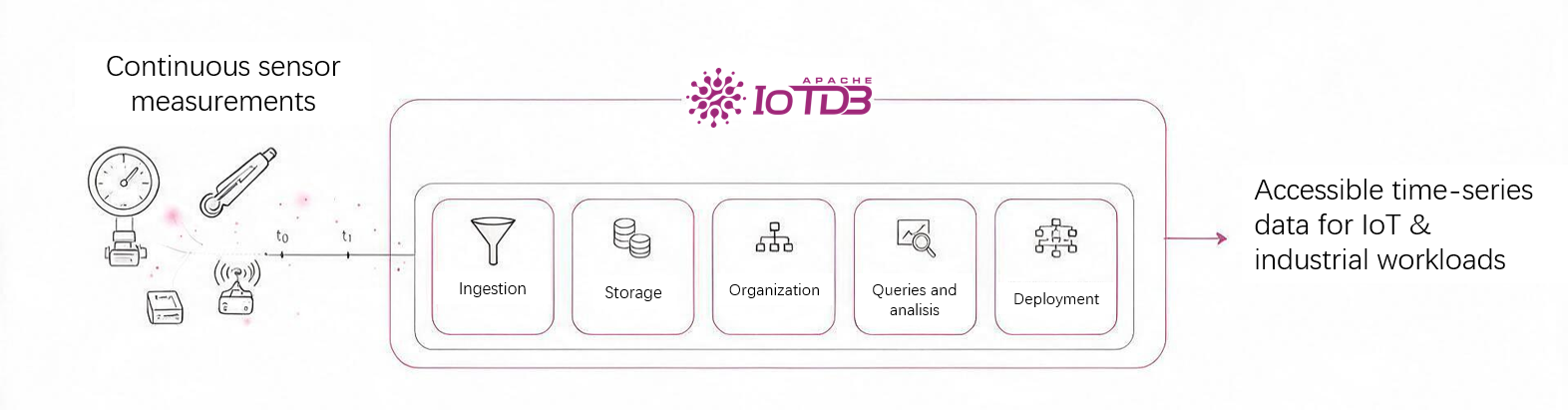
Continuous ingestion and retrieval
Industrial systems continuously receive timestamped measurements from many devices, often at different frequencies and in bursts. This creates a sustained write workload that must preserve device, measurement, and event-time context.
Apache IoTDB organizes data by device, measurement, and event time, and supports high-throughput ingestion of multi-frequency and out-of-order data. Recent and historical measurements remain available through time-based queries, allowing applications to retrieve the latest device state or examine an earlier operating window in the same system.
Storage efficiency for growing history
Apache IoTDB uses Apache TsFile as its underlying storage format. Now an Apache Top-Level Project, TsFile is an open-source columnar file format designed for industrial time-series datasets. It organizes, encodes, and compresses timestamps and values according to their data patterns, reducing repetition as historical data grows.
TsFile maintains schema, metadata, and statistics that help locate relevant data for time-range or value-based queries. Its file layout supports high-throughput reads and writes, fast random access, and selective reads without scanning the entire dataset. Multi-language interfaces also allow TsFile to be integrated into workflows for dataset management, analytics, and AI model training.
Flexible data models supporting IT-OT convergence
IoT data needs to preserve where each signal comes from. In a factory, this context may follow a hierarchy such as site → workshop → production line → machine → sensor. Such a structure reflects the asset and equipment models familiar to OT teams. IT developers, by contrast, may prefer tables in which identifying columns describe devices and measurement columns store observed values.
Flattening every asset relationship into a generic table can make the schema harder for OT users to navigate, while forcing every workload into a hierarchy may not suit the SQL-oriented analytics developed by IT teams.
Apache IoTDB supports both tree and table models within the same database platform. The tree model represents devices and measurements through hierarchical paths, allowing the data structure to reflect equipment hierarchies used in OT environments. The table model organizes data through tables and typed columns, providing a familiar, SQL-oriented interface for IT applications. Both models keep timestamps central while allowing teams to choose the representation that better fits their workflows. Together, the two model structures allow Apache IoTDB to accommodate a broader range of time-series data management requirements.
Queries that follow time
Operational questions are usually bounded by time, such as calculating the average temperature during the last hour or comparing vibration and current over the same interval. These queries become more difficult when signals use different sampling frequencies.
Apache IoTDB supports time-range filtering, built-in aggregations such as minimum, maximum, count, and average, and timestamp-aligned query results across multiple series. Applications can retrieve and summarize a selected interval within the database, while aligned results organize values by timestamp for cross-signal comparison. This reduces the amount of data returned by aggregation queries and the client-side work needed to combine separate series.
Handling out-of-order data
IoT measurements do not always arrive in timestamp order because network delays, buffering, or retries can postpone delivery. If a system treats arrival order as the operational timeline, historical queries and aggregations can misrepresent what happened.
Apache IoTDB accepts event timestamps with incoming measurements and supports ingestion when records arrive out of order. During queries, data is presented according to its timestamp rather than the order in which it reached the server. This allows a delayed 10:00 reading to remain part of the 10:00 time window even if it was received after data from 10:01.
Flexible deployment and scaling across IoT environments
Apache IoTDB can run in different deployment forms, from lightweight or standalone instances near the data source to distributed clusters for centralized management. IoTDB can synchronize newly ingested data in real time between deployments and can also transfer existing TsFiles directly. These options let teams collect data at the edge and analyze it centrally while preserving the device identity and original timestamp of each measurement.
In distributed deployments, Apache IoTDB also supports storage–compute separation and flexible resource scaling for IoT workloads. A newly added node can expand compute capacity without requiring historical data to be migrated first, while computation can remain close to the data to avoid unnecessary transfer overhead. This gives deployments greater flexibility to adapt as data volumes and processing demands change.
Where time-series data management is useful
The sectors differ, but the underlying pattern is the same: equipment or infrastructure produces measurements that teams need to retain and examine over time. Apache IoTDB can support time-series data management in scenarios such as:
Energy and power: measurements from generators, transformers, meters, and substations can support monitoring operating conditions and investigating abnormal changes.
Aerospace: telemetry and test measurements such as temperature, pressure, vibration, and position can be organized for monitoring and test analysis.
Transportation: vehicles and rail infrastructure generate data about speed, location, energy use, equipment status, and operating conditions.
Steel, metallurgy, and manufacturing: motors, furnaces, production lines, robots, and environmental sensors produce data for operational monitoring and historical review.
Connected infrastructure: buildings and environmental systems generate readings such as temperature, humidity, pressure, and energy consumption.
Conclusion
From continuous ingestion and efficient storage with Apache TsFile to time-oriented queries and flexible deployment, Apache IoTDB provides an open-source data foundation for industrial time-series data. These capabilities help users keep growing measurement histories available for operational queries and longer-term analysis.
Apache IoTDB also supports AI-oriented time-series analysis through AINode, which connects data managed in IoTDB with model training and inference. It supports time-series foundation models such as the Timer series for forecasting. Outside IoTDB, Hugging Face Datasets can load TsFiles directly for dataset and model workflows. Readers can explore the AINode documentation and the Hugging Face Datasets guide to TsFile for details.
Explore the Apache IoTDB website or the project on GitHub to learn more.


