
Query Data
Query Data
1. Syntax Overview
SELECT ⟨select_list⟩
    FROM ⟨tables⟩ | patternRecognition
    [WHERE ⟨condition⟩]
    [GROUP BY ⟨groups⟩]
    [HAVING ⟨group_filter⟩]
    [WINDOW windowDefinition (',' windowDefinition)*)]
    [FILL ⟨fill_methods⟩]
    [ORDER BY ⟨order_expression⟩]
    [OFFSET ⟨n⟩]
    [LIMIT ⟨n⟩];
The IoTDB table model query syntax supports the following clauses:
- SELECT Clause: Specifies the columns to be included in the result. Details: SELECT Clause
- FROM Clause: Indicates the data source for the query, which can be a single table, multiple tables joined using the
JOINclause, or a subquery. Details: FROM & JOIN Clause - WHERE Clause: Filters rows based on specific conditions. Logically executed immediately after the
FROMclause. Details: WHERE Clause - GROUP BY Clause: Used for aggregating data, specifying the columns for grouping. Details: GROUP BY Clause
- HAVING Clause: Applied after the
GROUP BYclause to filter grouped data, similar toWHEREbut operates after grouping. Details:HAVING Clause - FILL Clause: Handles missing values in query results by specifying fill methods (e.g., previous or next non-null value, or linear interpolation) for better visualization and analysis. Details: FILL Clause
- ORDER BY Clause: Sorts query results in ascending (
ASC) or descending (DESC) order, with optional handling for null values (NULLS FIRSTorNULLS LAST). Details: ORDER BY Clause - OFFSET Clause: Specifies the starting position for the query result, skipping the first
OFFSETrows. Often used with theLIMITclause. Details: LIMIT and OFFSET Clause - LIMIT Clause: Limits the number of rows in the query result. Typically used in conjunction with the
OFFSETclause for pagination. Details: LIMIT and OFFSET Clause
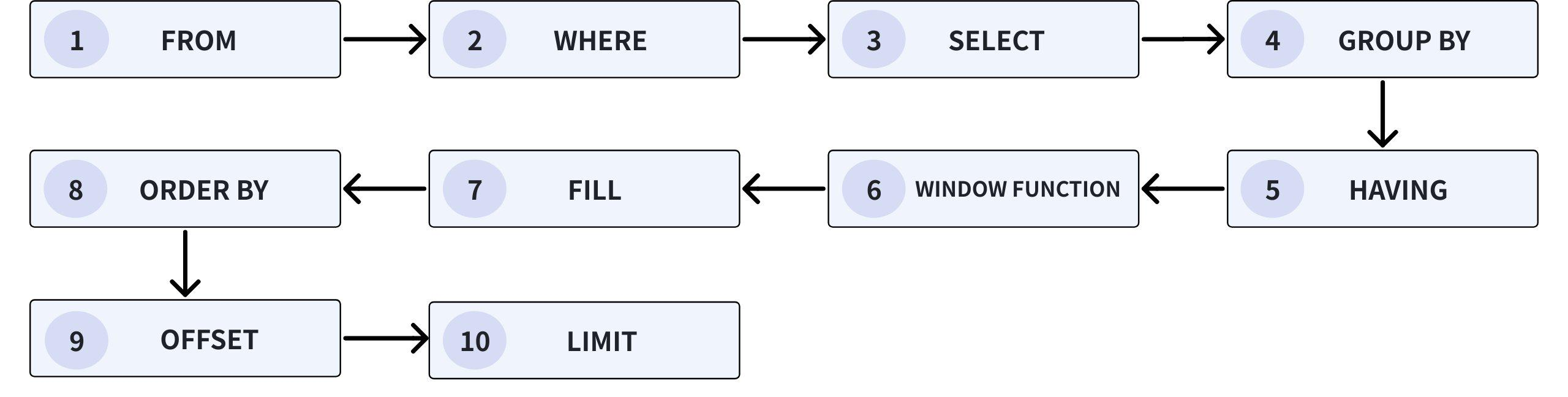
2. Clause Execution Order
3. Common Query Examples
3.1 Sample Dataset
The Example Data pagepage provides SQL statements to construct table schemas and insert data. By downloading and executing these statements in the IoTDB CLI, you can import the data into IoTDB. This data can be used to test and run the example SQL queries included in this documentation, allowing you to reproduce the described results.
3.2 Basic Data Query
Example 1: Filter by Time
IoTDB> SELECT time, temperature, humidity
         FROM table1
WHERE time >= 2024-11-27 00:00:00 and time <= 2024-11-29 00:00:00;Result:
+-----------------------------+-----------+--------+
|                         time|temperature|humidity|
+-----------------------------+-----------+--------+
|2024-11-28T08:00:00.000+08:00|       85.0|    null|
|2024-11-28T09:00:00.000+08:00|       null|    40.9|
|2024-11-28T10:00:00.000+08:00|       85.0|    35.2|
|2024-11-28T11:00:00.000+08:00|       88.0|    45.1|
|2024-11-27T16:38:00.000+08:00|       null|    35.1|
|2024-11-27T16:39:00.000+08:00|       85.0|    35.3|
|2024-11-27T16:40:00.000+08:00|       85.0|    null|
|2024-11-27T16:41:00.000+08:00|       85.0|    null|
|2024-11-27T16:42:00.000+08:00|       null|    35.2|
|2024-11-27T16:43:00.000+08:00|       null|    null|
|2024-11-27T16:44:00.000+08:00|       null|    null|
+-----------------------------+-----------+--------+
Total line number = 11
It costs 0.075s
Example 2: Filter by Value
IoTDB> SELECT time, temperature, humidity
         FROM table1
WHERE temperature > 89.0;Result:
+-----------------------------+-----------+--------+
|                         time|temperature|humidity|
+-----------------------------+-----------+--------+
|2024-11-29T18:30:00.000+08:00|       90.0|    35.4|
|2024-11-26T13:37:00.000+08:00|       90.0|    35.1|
|2024-11-26T13:38:00.000+08:00|       90.0|    35.1|
|2024-11-30T09:30:00.000+08:00|       90.0|    35.2|
|2024-11-30T14:30:00.000+08:00|       90.0|    34.8|
+-----------------------------+-----------+--------+
Total line number = 5
It costs 0.156s
Example 3: Filter by Attribute
IoTDB> SELECT time, temperature, humidity
         FROM table1
WHERE model_id ='B';Result:
+-----------------------------+-----------+--------+
|                         time|temperature|humidity|
+-----------------------------+-----------+--------+
|2024-11-27T16:38:00.000+08:00|       null|    35.1|
|2024-11-27T16:39:00.000+08:00|       85.0|    35.3|
|2024-11-27T16:40:00.000+08:00|       85.0|    null|
|2024-11-27T16:41:00.000+08:00|       85.0|    null|
|2024-11-27T16:42:00.000+08:00|       null|    35.2|
|2024-11-27T16:43:00.000+08:00|       null|    null|
|2024-11-27T16:44:00.000+08:00|       null|    null|
+-----------------------------+-----------+--------+
Total line number = 7
It costs 0.106s
Example 3:Multi device time aligned query
IoTDB> SELECT date_bin_gapfill(1d, TIME) AS a_time,
              device_id,
              AVG(temperature) AS avg_temp
       FROM table1
       WHERE TIME >= 2024-11-26 13:00:00
         AND TIME <= 2024-11-27 17:00:00
GROUP BY 1, device_id FILL METHOD PREVIOUS;Result:
+-----------------------------+---------+--------+
|                       a_time|device_id|avg_temp|
+-----------------------------+---------+--------+
|2024-11-26T08:00:00.000+08:00|      100|    90.0|
|2024-11-27T08:00:00.000+08:00|      100|    90.0|
|2024-11-26T08:00:00.000+08:00|      101|    90.0|
|2024-11-27T08:00:00.000+08:00|      101|    85.0|
+-----------------------------+---------+--------+
Total line number = 4
It costs 0.048s
3.3 Aggregation Query
Example: Calculate the average, maximum, and minimum temperature for each device_id within a specific time range.
IoTDB> SELECT device_id, AVG(temperature) as avg_temp, MAX(temperature) as max_temp, MIN(temperature) as min_temp
         FROM table1
         WHERE time >= 2024-11-26 00:00:00 AND time <= 2024-11-29 00:00:00
GROUP BY device_id;Result:
+---------+--------+--------+--------+
|device_id|avg_temp|max_temp|min_temp|
+---------+--------+--------+--------+
|      100|    87.6|    90.0|    85.0|
|      101|    85.0|    85.0|    85.0|
+---------+--------+--------+--------+
Total line number = 2
It costs 0.278s
3.4 Latest Point Query
Example: Retrieve the latest record for each device_id, including the temperature value and the timestamp of the last record.
IoTDB> SELECT device_id,last(time),last_by(temperature,time)
         FROM table1
GROUP BY device_id;Result:
+---------+-----------------------------+-----+
|device_id|                        _col1|_col2|
+---------+-----------------------------+-----+
|      100|2024-11-29T18:30:00.000+08:00| 90.0|
|      101|2024-11-30T14:30:00.000+08:00| 90.0|
+---------+-----------------------------+-----+
Total line number = 2
It costs 0.090s
3.5 Downsampling Query
Example: Group data by day and calculate the average temperature using date_bin_gapfill function.
IoTDB> SELECT device_id,date_bin(1d ,time) as day_time, AVG(temperature) as avg_temp
         FROM table1
         WHERE time >= 2024-11-26 00:00:00 AND time <= 2024-11-30 00:00:00
GROUP BY device_id,date_bin(1d ,time);Result:
+---------+-----------------------------+--------+
|device_id|                     day_time|avg_temp|
+---------+-----------------------------+--------+
|      100|2024-11-29T08:00:00.000+08:00|    90.0|
|      100|2024-11-28T08:00:00.000+08:00|    86.0|
|      100|2024-11-26T08:00:00.000+08:00|    90.0|
|      101|2024-11-29T08:00:00.000+08:00|    85.0|
|      101|2024-11-27T08:00:00.000+08:00|    85.0|
+---------+-----------------------------+--------+
Total line number = 5
It costs 0.066s
3.6 Multi device downsampling alignment query
3.6.1 Sampling Frequency is the Same, but Time is Different
Table 1: Sampling Frequency: 1s
| Time | device_id | temperature |
|---|---|---|
| 00:00:00.001 | d1 | 90.0 |
| 00:00:01.002 | d1 | 85.0 |
| 00:00:02.101 | d1 | 85.0 |
| 00:00:03.201 | d1 | null |
| 00:00:04.105 | d1 | 90.0 |
| 00:00:05.023 | d1 | 85.0 |
| 00:00:06.129 | d1 | 90.0 |
Table 2: Sampling Frequency: 1s
| Time | device_id | humidity |
|---|---|---|
| 00:00:00.003 | d1 | 35.1 |
| 00:00:01.012 | d1 | 37.2 |
| 00:00:02.031 | d1 | null |
| 00:00:03.134 | d1 | 35.2 |
| 00:00:04.201 | d1 | 38.2 |
| 00:00:05.091 | d1 | 35.4 |
| 00:00:06.231 | d1 | 35.1 |
Example: Querying the downsampled data of table1:
IoTDB> SELECT date_bin_gapfill(1s, TIME) AS a_time,
              first(temperature) AS a_value
       FROM table1
       WHERE device_id = 'd1'
         AND TIME >= 2025-05-13 00:00:00.000
         AND TIME <= 2025-05-13 00:00:07.000
       GROUP BY 1 FILL METHOD PREVIOUS
Result:
+-----------------------------+-------+
|                       a_time|a_value|
+-----------------------------+-------+
|2025-05-13T00:00:00.000+08:00|   90.0|
|2025-05-13T00:00:01.000+08:00|   85.0|
|2025-05-13T00:00:02.000+08:00|   85.0|
|2025-05-13T00:00:03.000+08:00|   85.0|
|2025-05-13T00:00:04.000+08:00|   90.0|
|2025-05-13T00:00:05.000+08:00|   85.0|
|2025-05-13T00:00:06.000+08:00|   90.0|
+-----------------------------+-------+
Example: Querying the downsampled data of table2:
IoTDB> SELECT date_bin_gapfill(1s, TIME) AS b_time,
              first(humidity) AS b_value
       FROM table2
       WHERE device_id = 'd1'
         AND TIME >= 2025-05-13 00:00:00.000
         AND TIME <= 2025-05-13 00:00:07.000
       GROUP BY 1 FILL METHOD PREVIOUS
Result:
+-----------------------------+-------+
|                       b_time|b_value|
+-----------------------------+-------+
|2025-05-13T00:00:00.000+08:00|   35.1|
|2025-05-13T00:00:01.000+08:00|   37.2|
|2025-05-13T00:00:02.000+08:00|   37.2|
|2025-05-13T00:00:03.000+08:00|   35.2|
|2025-05-13T00:00:04.000+08:00|   38.2|
|2025-05-13T00:00:05.000+08:00|   35.4|
|2025-05-13T00:00:06.000+08:00|   35.1|
+-----------------------------+-------+
Example: Aligning multiple sequences by integer time:
IoTDB> SELECT time,
              a_value,
              b_value
       FROM
         (SELECT date_bin_gapfill(1s, TIME) AS time,
                 first(temperature) AS a_value
          FROM table1
          WHERE device_id = 'd1'
            AND TIME >= 2025-05-13 00:00:00.000
            AND TIME <= 2025-05-13 00:00:07.000
          GROUP BY 1 FILL METHOD PREVIOUS) A
       JOIN
         (SELECT date_bin_gapfill(1s, TIME) AS time,
                 first(humidity) AS b_value
          FROM table2
          WHERE device_id = 'd1'
            AND TIME >= 2025-05-13 00:00:00.000
            AND TIME <= 2025-05-13 00:00:07.000
          GROUP BY 1 FILL METHOD PREVIOUS) B
       USING (time)
Result:
+-----------------------------+-------+-------+
|                         time|a_value|b_value|
+-----------------------------+-------+-------+
|2025-05-13T00:00:00.000+08:00|   90.0|   35.1|
|2025-05-13T00:00:01.000+08:00|   85.0|   37.2|
|2025-05-13T00:00:02.000+08:00|   85.0|   37.2|
|2025-05-13T00:00:03.000+08:00|   85.0|   35.2|
|2025-05-13T00:00:04.000+08:00|   90.0|   38.2|
|2025-05-13T00:00:05.000+08:00|   85.0|   35.4|
|2025-05-13T00:00:06.000+08:00|   90.0|   35.1|
+-----------------------------+-------+-------+- Retaining NULL Values: When NULL values have special significance or when you wish to preserve the null values in the data, you can choose to omit FILL METHOD PREVIOUS to avoid filling in the gaps.
Example:
IoTDB> SELECT time,
              a_value,
              b_value
       FROM
         (SELECT date_bin_gapfill(1s, TIME) AS time,
                 first(temperature) AS a_value
          FROM table1
          WHERE device_id = 'd1'
            AND TIME >= 2025-05-13 00:00:00.000
            AND TIME <= 2025-05-13 00:00:07.000
          GROUP BY 1) A
       JOIN
         (SELECT date_bin_gapfill(1s, TIME) AS time,
                 first(humidity) AS b_value
          FROM table2
          WHERE device_id = 'd1'
            AND TIME >= 2025-05-13 00:00:00.000
            AND TIME <= 2025-05-13 00:00:07.000
          GROUP BY 1) B
       USING (time)
Result:
+-----------------------------+-------+-------+
|                         time|a_value|b_value|
+-----------------------------+-------+-------+
|2025-05-13T00:00:00.000+08:00|   90.0|   35.1|
|2025-05-13T00:00:01.000+08:00|   85.0|   37.2|
|2025-05-13T00:00:02.000+08:00|   85.0|   null|
|2025-05-13T00:00:03.000+08:00|   null|   35.2|
|2025-05-13T00:00:04.000+08:00|   90.0|   38.2|
|2025-05-13T00:00:05.000+08:00|   85.0|   35.4|
|2025-05-13T00:00:06.000+08:00|   90.0|   35.1|
+-----------------------------+-------+-------+
3.6.2 Different Sampling Frequencies, Different Times
Table 1: Sampling Frequency: 1s
| Time | device_id | temperature |
|---|---|---|
| 00:00:00.001 | d1 | 90.0 |
| 00:00:01.002 | d1 | 85.0 |
| 00:00:02.101 | d1 | 85.0 |
| 00:00:03.201 | d1 | null |
| 00:00:04.105 | d1 | 90.0 |
| 00:00:05.023 | d1 | 85.0 |
| 00:00:06.129 | d1 | 90.0 |
Table 3: Sampling Frequency: 2s
| Time | device_id | humidity |
|---|---|---|
| 00:00:00.005 | d1 | 35.1 |
| 00:00:02.106 | d1 | 37.2 |
| 00:00:04.187 | d1 | null |
| 00:00:06.156 | d1 | 35.1 |
Example: Querying the downsampled data of table1:
IoTDB> SELECT date_bin_gapfill(1s, TIME) AS a_time,
              first(temperature) AS a_value
       FROM table1
       WHERE device_id = 'd1'
         AND TIME >= 2025-05-13 00:00:00.000
         AND TIME <= 2025-05-13 00:00:07.000
       GROUP BY 1 FILL METHOD PREVIOUS
Result:
+-----------------------------+-------+
|                       a_time|a_value|
+-----------------------------+-------+
|2025-05-13T00:00:00.000+08:00|   90.0|
|2025-05-13T00:00:01.000+08:00|   85.0|
|2025-05-13T00:00:02.000+08:00|   85.0|
|2025-05-13T00:00:03.000+08:00|   85.0|
|2025-05-13T00:00:04.000+08:00|   90.0|
|2025-05-13T00:00:05.000+08:00|   85.0|
|2025-05-13T00:00:06.000+08:00|   90.0|
+-----------------------------+-------+
Example: Querying the downsampled data of table3:
IoTDB> SELECT date_bin_gapfill(1s, TIME) AS c_time,
              first(humidity) AS c_value
       FROM table3
       WHERE device_id = 'd1'
         AND TIME >= 2025-05-13 00:00:00.000
         AND TIME <= 2025-05-13 00:00:07.000
       GROUP BY 1 FILL METHOD PREVIOUS
Result:
+-----------------------------+-------+
|                       c_time|c_value|
+-----------------------------+-------+
|2025-05-13T00:00:00.000+08:00|   35.1|
|2025-05-13T00:00:01.000+08:00|   35.1|
|2025-05-13T00:00:02.000+08:00|   37.2|
|2025-05-13T00:00:03.000+08:00|   37.2|
|2025-05-13T00:00:04.000+08:00|   37.2|
|2025-05-13T00:00:05.000+08:00|   37.2|
|2025-05-13T00:00:06.000+08:00|   35.1|
+-----------------------------+-------+
Example: Aligning multiple sequences by the higher sampling frequency:
IoTDB> SELECT time,
              a_value,
              c_value
       FROM
         (SELECT date_bin_gapfill(1s, TIME) AS time,
                 first(temperature) AS a_value
          FROM table1
          WHERE device_id = 'd1'
            AND TIME >= 2025-05-13 00:00:00.000
            AND TIME <= 2025-05-13 00:00:07.000
          GROUP BY 1 FILL METHOD PREVIOUS) A
       JOIN
         (SELECT date_bin_gapfill(1s, TIME) AS time,
                 first(humidity) AS c_value
          FROM table3
          WHERE device_id = 'd1'
            AND TIME >= 2025-05-13 00:00:00.000
            AND TIME <= 2025-05-13 00:00:07.000
          GROUP BY 1 FILL METHOD PREVIOUS) C
       USING (time)
Result:
+-----------------------------+-------+-------+
|                         time|a_value|c_value|
+-----------------------------+-------+-------+
|2025-05-13T00:00:00.000+08:00|   90.0|   35.1|
|2025-05-13T00:00:01.000+08:00|   85.0|   35.1|
|2025-05-13T00:00:02.000+08:00|   85.0|   37.2|
|2025-05-13T00:00:03.000+08:00|   85.0|   37.2|
|2025-05-13T00:00:04.000+08:00|   90.0|   37.2|
|2025-05-13T00:00:05.000+08:00|   85.0|   37.2|
|2025-05-13T00:00:06.000+08:00|   90.0|   35.1|
+-----------------------------+-------+-------+
3.7 Missing Data Filling
Example: Query the records within a specified time range where device_id is '100'. If there are missing data points, fill them using the previous non-null value.
IoTDB> SELECT time, temperature, humidity
         FROM table1
         WHERE time >= 2024-11-26 00:00:00  and time <= 2024-11-30 11:00:00
         AND region='East' AND plant_id='1001' AND device_id='101'
FILL METHOD PREVIOUS;Result:
+-----------------------------+-----------+--------+
|                         time|temperature|humidity|
+-----------------------------+-----------+--------+
|2024-11-27T16:38:00.000+08:00|       null|    35.1|
|2024-11-27T16:39:00.000+08:00|       85.0|    35.3|
|2024-11-27T16:40:00.000+08:00|       85.0|    35.3|
|2024-11-27T16:41:00.000+08:00|       85.0|    35.3|
|2024-11-27T16:42:00.000+08:00|       85.0|    35.2|
|2024-11-27T16:43:00.000+08:00|       85.0|    35.2|
|2024-11-27T16:44:00.000+08:00|       85.0|    35.2|
+-----------------------------+-----------+--------+
Total line number = 7
It costs 0.101s
3.8 Sorting & Pagination
Example: Query records from the table, sorting by humidity in descending order and placing null values (NULL) at the end. Skip the first 2 rows and return the next 8 rows.
IoTDB> SELECT time, temperature, humidity
         FROM table1
         ORDER BY humidity desc NULLS LAST
         OFFSET 2
LIMIT 10;Result:
+-----------------------------+-----------+--------+
|                         time|temperature|humidity|
+-----------------------------+-----------+--------+
|2024-11-28T09:00:00.000+08:00|       null|    40.9|
|2024-11-29T18:30:00.000+08:00|       90.0|    35.4|
|2024-11-27T16:39:00.000+08:00|       85.0|    35.3|
|2024-11-28T10:00:00.000+08:00|       85.0|    35.2|
|2024-11-30T09:30:00.000+08:00|       90.0|    35.2|
|2024-11-27T16:42:00.000+08:00|       null|    35.2|
|2024-11-26T13:38:00.000+08:00|       90.0|    35.1|
|2024-11-26T13:37:00.000+08:00|       90.0|    35.1|
|2024-11-27T16:38:00.000+08:00|       null|    35.1|
|2024-11-30T14:30:00.000+08:00|       90.0|    34.8|
+-----------------------------+-----------+--------+
Total line number = 10
It costs 0.093s